Behaviour Curriculum
Behaviour Policy
Anti-Bullying Policy
At Sir Alexander Fleming Primary School and Nursery, our approach empowers pupils to make positive choices, reflect when things go wrong, and build the skills needed to self-regulate and restore relationships.
We believe every child can succeed when behaviour is understood as communication, and when reflection replaces reaction.
‘Keep your thoughts positive because your thoughts become your words. Keep your words positive because your words become your behaviour.’ Mahatma Gandhi
What do our children think about our Behaviour Systems?
“Opportunities can never be reached unless you are well-behaved”
“Our rocket system works well as it shows the children that they have consequences”
“The teachers are fair and follow through with the consequences”
“It is a good system because there are lots of people to talk to who support you, like the SLT, Rainbow Room, Mrs Fisher, behaviour mentors”
“You can go to the calm room if you feel stressed or worried”
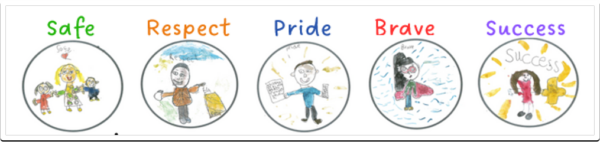
School Values
Our values underpin our aims, with rules presented in a positive way as appropriate. Expectations are discussed, clearly explained, and consistently reinforced so that all children and adults understand why they are important:
- for reasons of safety.
- respect for others and their property.
- for the smooth running of our school.
Everyone has a right to feel safe at school. The staff at Sir Alexander Fleming Primary School and Nursery are committed to ensuring that every child is protected from harm. Everyone is of equal value and will be valued equally regardless of whether they have a disability, whatever their ethnicity, culture, religious affiliation, national origin, or national status, whatever their gender and gender identity and whatever their sexual identity.
It is everyone’s responsibility to help make our school a happy place where everyone can be successful. We expect that the respectful behaviour of children will enable teachers to teach, and each other to learn. Everyone is responsible for their own behaviour and our expectation is for good behaviour offline and online. Good behaviour is something to be proud of and so is rewarded and celebrated. The education of many children will be protected from disruption by a minority who are demonstrating unacceptable behaviour; this will be met with consequences. Parents will be informed about the expectations of the school and about the consequences if the child behaves inappropriately in school, in the community and online.
Aims
- To create a welcoming and safe learning environment in which everyone can be successful.
- Develop a fair and consistent approach across the school, which all children know, understand, and can articulate.
- Create an atmosphere where social, moral, spiritual and cultural values are learnt and developed and celebrated, with a strong emphasis placed upon ‘British Values’.
Expectations
We expect everyone in our school to:
- have high expectations of behaviour
- show respect to each other
- develop an increasingly sound understanding of right and wrong
- co-operate and work together
- recognise the achievements of others
- be reliable, trustworthy and responsible
- behave in a safe manner at all times
- respect the school’s environment and belongings
- take care of their own belongings and those of other children
- be courteous and well-mannered at all times
- show by their behaviour that they value the school community
- treat others as we would like to be treated.
Promoting Good Behaviour
Good behaviour is developed when everyone remembers to consistently do what is expected of them:
Staff focus on positive behaviours and praise children appropriately.
- All staff maintain a calm approach at all times, supporting each other where needed.
- Our school has a no shouting ethos which all staff members adhere too.
- Staff explain to children clearly and consistently what is expected of them. They model the highest standards of respect at all times.
- If children are to be spoken with about their behaviour, this is done discretely, in all situations.
- Children remember and demonstrate what is expected of them.
- School and classroom expectations are consistent, fair, related to our values and adhered to.
- Expectations are regularly discussed and reviewed by staff and children together.
- Responsibilities and activities are matched to each pupil’s age, needs and stages of development.
- Staff inform children’s parents/carers of good behaviour or achievements.
- Examples of excellent work are celebrated with other children.
- Throughout the curriculum, and specifically in SMSC and RE lessons, children are taught the reasons why good behaviour is essential in our society and how behaviour can spoil the lives of others and restrict their own life opportunities.
- In assemblies’ children are encouraged to reflect and to think about others. Children’s individual achievements are celebrated with certificates in our weekly Celebration Assemblies.
- In all subjects children are taught the skills of resourcefulness, reciprocity, resilience and reflectiveness.
How is impact measured?
Progress:
- Behaviour trends are continuously monitored through CPOMS data, pastoral tracking, and pupil reflection logs.
- Regular review meetings and half-termly analysis enable staff to identify progress in self-regulation, consistency of positive choices, and reductions in resets or referrals over time.
Outcomes:
- Pupils demonstrate growing emotional literacy, resilience, and readiness to learn.
- They confidently use shared visual language to describe behaviour expectations and can articulate how to “reset their mindset” when challenges arise.
- This results in calm, purposeful learning environments and high engagement across the curriculum.
Intervention:
- Behaviour data identifies individuals and groups requiring targeted pastoral or SEND support.
- Tailored interventions, restorative sessions, and one-to-one mentoring ensure no pupil is left behind.
- Where needed, specialist support from the Pastoral Team, SENDCo, or external agencies provides additional guidance and strategies for long-term success.
Subject Knowledge, Skills and Vocabulary:
Our behaviour curriculum develops emotionally literate, reflective learners who understand themselves and others.
Pupils gain:
-
Self-regulation and emotional understanding – recognising and managing feelings through the Zones of Regulation
-
Reflection and responsibility – understanding that behaviour is a choice and learning how to repair and restore relationships.
-
Resilience and perseverance – developing strategies to remain calm, adapt and recover from setbacks.
-
Respectful communication – using positive language, active listening and empathy to resolve conflict.
-
Social awareness and citizenship – understanding rights, responsibilities and their role within the school community.
-
Behavioural vocabulary – confidently using terms such as regulate, reflect, restore, empathy, mindset, resilience and reset to describe actions and choices.
How are we inclusive?
We have high expectations of all of our pupils’ behaviour. The format in which the behaviour system is presented to pupils may differ according to pupil’s needs to allow access for all. Our SEND leader works in unison with the Pastoral Team to ensure pupils access support.
Support for pupils is demonstrated using a successive wave approach:
Wave 1 – Part of High Quality Teaching:
- Use of a pastoral pack of resources to support planning sessions.
- Class environments are calming, uncluttered and promote learning.
- Visual Timetable displayed in every class, and referred to throughout the day.
- Zones of Regulation check-ins at least daily.
- Use of 6 steps to trauma sensitive connection when dealing with pupil behaviour.
- Use of resources from SEN toolkits that promote and support positive behaviour.
- Reasonable adjustments such as ‘chunking’ tasks, use of timers, sticker charts and rewards
Wave 2 – Targeted support for small groups of children or individuals.
Wave 3 – Specialist support from Pastoral Team and/or External agencies.